At Col de Crie, a forest 200 years in the making
Explore the forest shaped by planting in the Haut-Beaujolais, its timber history, and the Vert Horizon exhibition and family activities at Col de Crie in autumn 2026.
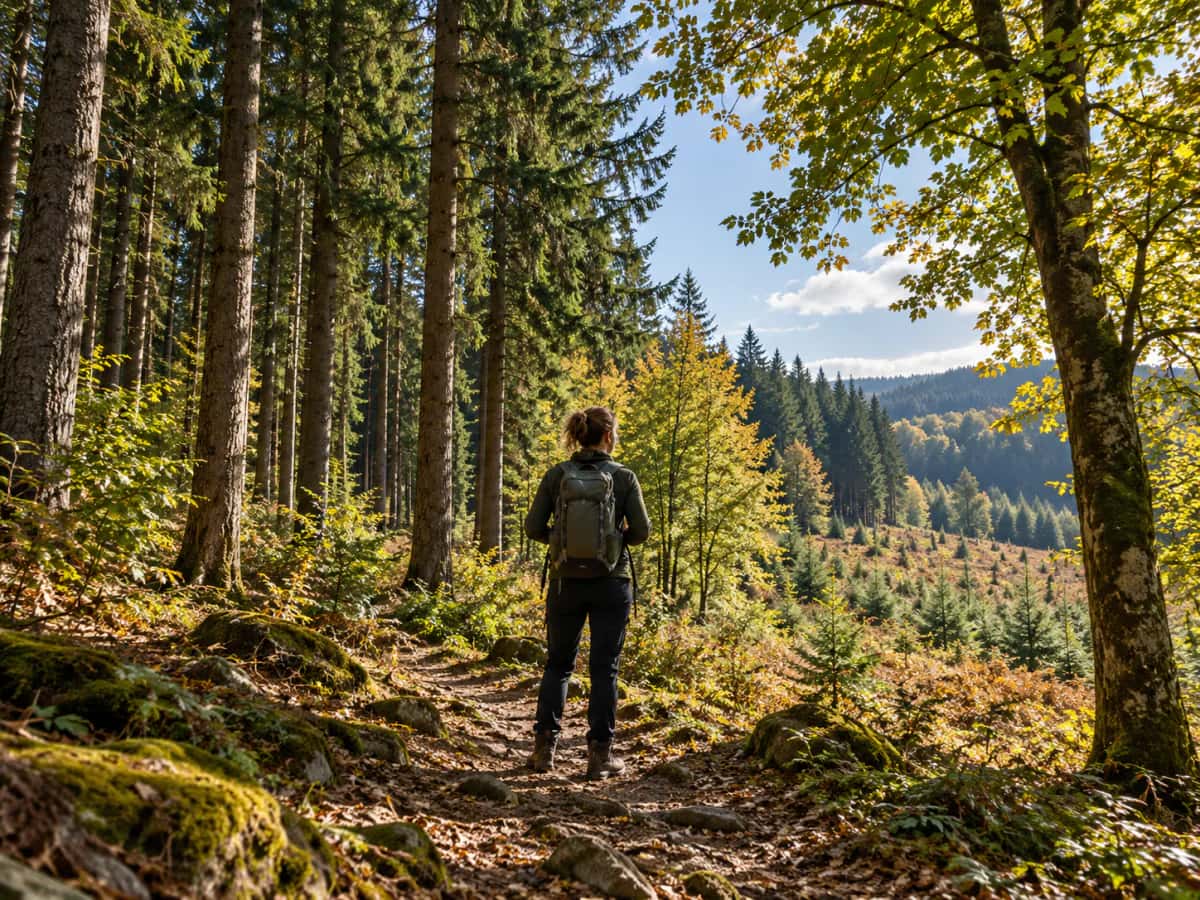
From the Col de Crie, the wooded ridges of the Haut-Beaujolais can look older than the villages below them. After a day among the vineyards further east, it is easy to read the dark slopes as untouched nature. The view tells a less simple story. Much of the forest landscape grew through planting and an economy built around timber, on land whose uses had changed.
That history is the subject of Vert Horizon, an exhibition at the Maison de la Randonnée et du Trail this autumn. It also changes what you notice outside: the trees, the openings and the tracks that reveal how people have used these slopes. The forest is alive, but it is also a record of work.
The hills did not always wear this much forest
Some woodland remained in the Monts du Beaujolais before the forest expanded again. From the nineteenth century, declining agricultural use and public encouragement of planting helped change the slopes. The Communauté d’agglomération de l’Ouest Rhodanien connects the development of today's timber-producing forest to a departmental policy responding to agricultural decline. The change continued over many decades and became especially strong after the Second World War. A landscape almost two centuries in the making cannot be reduced to a single planting campaign.
That is a regional history, not a claim that every tree here was planted. Woodland can regenerate, spread and change after planting. Nor does “planted” make a forest fake. It tells you that decisions about land, labour and income sit behind what looks natural from a distance.
Visitors often meet Beaujolais through its vines. In the wine country, a row of Gamay is readily understood as cultivated land. On the higher, more wooded side, the same human role is easier to miss. To read the Haut-Beaujolais, look beyond the green outline and ask what each patch of land was expected to provide.
Douglas fir changed the colour and economy of the slopes
Timber is central to this story. The local authority describes a productive forest dominated by conifers, with Douglas fir a defining species. The straight trunks and regular blocks you may notice on a walk can make forestry work visible, although one viewpoint cannot tell you who owns a stand or how it is managed.
Douglas fir became prominent as the forest expanded and forestry developed. The Beaujolais Geopark's account of the natural environment also draws attention to old trees, dead wood and the life sheltered beneath the canopy. That does not erase timber production. It broadens the view: this is a working forest with habitats and living things a visitor might otherwise overlook.
Wood production brings visible interventions. Trees are tended and harvested; access routes reach the stands. A harvested opening can look abrupt to a walker who expected uninterrupted canopy. It also makes the choices behind the next generation of trees easier to see. A forest planted for one purpose inherits many others.
A path can show more than the panorama
At Col de Crie, the Vert Horizon programme presents the history of the Monts du Beaujolais forest in the Maison de la Randonnée et du Trail's exhibition space. The organiser lists it from 7 October to 1 November 2026, with free entry. Start indoors if you can: the exhibition gives a historical frame for what you will see outside.
The venue also offers Surprenante forêt!, a family activity running from 17 October to 1 November. Its two options suit different ages and amounts of time. The eight-kilometre puzzle walk is for children aged 7–13, takes about two to two and a half hours, and has a last departure at 3 pm. The game in the park is for ages 4–7, takes about an hour, and has a last departure at 4.30 pm. The kit costs €3. Follow the organiser's current instructions for the activity you choose; the published distance does not provide a route map.
On either activity, look for traces of changing land use. Notice where dense conifers give way to other trees or open ground. Look at tracks without assuming every track is a tourist trail. The exhibition explains the broad history; time outdoors lets you recognise part of that history in a particular place.
A short stop, or time among the trees
The Maison is at Col de Crie. Both the exhibition and the family activity end on 1 November. As of 23 October 2026, the venue's autumn schedule says it opens Tuesday to Sunday, 10 am–6 pm, during the school holidays and closes on Monday. The exhibition listing gives Wednesday to Sunday, 10 am–6 pm. Its availability on Tuesday is therefore uncertain even though the Maison is open; check with the organiser before travelling for the exhibition that day. Bring shoes suited to a forest path and check the weather if you plan to walk.
If you have only a short stop, the exhibition alone can overturn the assumption that the wooded hills have always looked this way. If you can walk, let the details interrupt the postcard view. The vineyard and the forest are both working landscapes, but they make their labour visible in different ways. Vines announce cultivation in straight rows; the woods hide a longer sequence of abandoned agricultural use, planting, growth and harvest.
The wooded slopes at Col de Crie carry a history of planting and work. What remains open is how timber production, habitats and visitors will share them in the years ahead.
Explore more History of the Beaujolais Region stories and the complete About guide.