Château de La Chaize at 350: how the “Versailles of Beaujolais” is reinventing Gamay
Discover how Château de La Chaize celebrates 350 years by combining royal heritage, organic viticulture and a bold vision for the future of Beaujolais.
Some wine estates impress because of their bottles. Château de La Chaize does something rarer: it impresses before the first glass is poured.
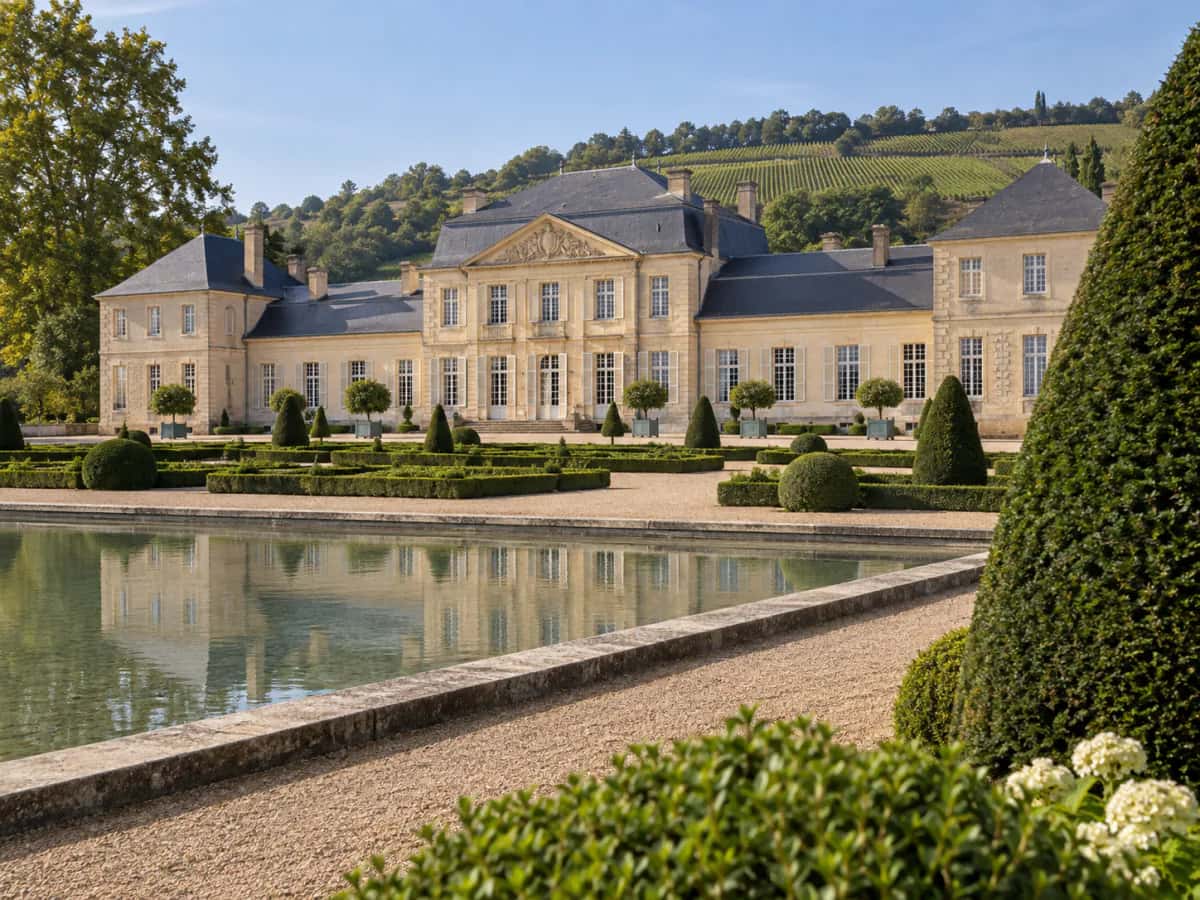
Set in Odenas, at the foot of Mont Brouilly, this 17th-century estate is often called the “Versailles of Beaujolais”. The nickname is not just poetic. The château was built between 1674 and 1676 on plans associated with Jules Hardouin-Mansart, the great architect of Louis XIV, while its formal gardens are attributed to André Le Nôtre. Today, as the estate prepares to mark 350 years of history, La Chaize is no longer only a monument to the Grand Siècle. It has become one of the most ambitious experiments in modern Beaujolais.
Why this château matters in Beaujolais
Beaujolais is often loved for its villages, granite hillsides, family domaines and approachable Gamay. La Chaize belongs to that world, but on another scale.
The property covers about 450 hectares, with 106 hectares of vines, making it one of the largest wine estates in Beaujolais. Recent reporting has described a major investment programme launched after its purchase by Christophe Gruy in 2017, with more than €100 million committed to restoration, viticulture, cellars and hospitality.
Its size alone is not the point. What makes La Chaize interesting is the way it uses scale to read terroir more precisely. Rather than treating Gamay as one simple, fruity red wine, the estate works through lieux-dits, separate parcels and geological contrasts: granite, sandy decomposed rock, volcanic “blue stone” on the slopes of Mont Brouilly.
For anyone trying to understand Beaujolais beyond Nouveau, this is a useful lesson. Gamay is not one flavour. In Brouilly, it can be generous and bright. On Côte de Brouilly’s volcanic soils, it becomes more mineral and structured. In Fleurie, it often turns more floral and delicate. In Morgon, it can gain depth, flesh and ageing potential.
A royal landscape built for wine
La Chaize was not designed like an ordinary wine farm. Its long perspectives, symmetrical façade and formal gardens bring the language of royal France into the Beaujolais hills.
The estate’s heritage also includes a historic vat room and a 108-metre cellar, both part of the site’s appeal for visitors today. La Vallée de la Gastronomie describes the property as a listed Monument Historique, with château, gardens, vat room and long cellar forming a rare wine heritage ensemble.
That combination explains the estate’s visual power. It is not just a beautiful building beside vines. It is a landscape where architecture, gardens and viticulture were conceived as one theatrical whole.
The 2017 turning point
For centuries, La Chaize remained tied to family history. The decisive modern shift came in 2017, when Christophe Gruy acquired the estate and began a major restoration and transformation project.
The ambition was not only to renovate the château. It was to rebuild the wine project from the ground up: vineyard management, cellar work, energy use, hospitality and brand positioning. Le Monde described the investment as aimed at reviving a “sleeping beauty” of Beaujolais and turning it into a reference point for quality Gamay.
That may sound grand, but the logic is simple: if Beaujolais wants to escape old clichés, it needs places that prove the region can produce serious, precise, site-driven wines without losing its freshness.
Organic Gamay and a low-carbon ambition
La Chaize’s recent evolution is also environmental. The estate’s vineyards are certified organic from the 2022 vintage, according to its [importer Vintus].
The project goes further than organic farming. The estate presents its new facilities as part of an energy and environmental transition, including a geothermal system with 28 wells drilled over 200 metres deep to regulate the temperature of the winery and tanks.
That detail matters because temperature control is a major part of modern winemaking. Using geothermal energy to support that process fits the estate’s broader ambition: reduce fossil energy, manage resources more intelligently and make high-quality wine with a lighter environmental footprint.
What this means in the glass
For drinkers, the most important question is not whether La Chaize is impressive. It is whether the wines explain Beaujolais better.
At its best, the estate’s approach helps make the region more legible. A Brouilly from a walled monopole, a Côte de Brouilly from volcanic slopes, a Fleurie from granitic sands and a Morgon from more structured soils do not tell the same story. They show how Gamay reacts to place.
That is why La Chaize matters beyond its own labels. It supports a broader movement in Beaujolais: growers and estates showing that the region is not limited to easy-drinking red wine. Beaujolais can be fresh and serious, joyful and precise, immediate and age-worthy.
Visiting Château de La Chaize today
For travellers, La Chaize is one of the most complete stops in the region. A visit can connect several layers of Beaujolais in one place: royal architecture, French gardens, historic cellars, Brouilly terroir, organic viticulture and contemporary winemaking.
The estate reopened to visitors after its recent transformation and now offers structured tours, including routes focused on the gardens, the cellars and the wines. That level of organisation is useful for international visitors, especially those who want a polished introduction to Beaujolais heritage. It also means the experience can feel more curated than spontaneous: standard tastings may not include the most prestigious cuvées, and travellers looking for a deep historical immersion should choose their visit format carefully.
La Chaize also works well as part of a wider route around Mont Brouilly, the crus and the golden-stone villages of southern Beaujolais. Readers planning a trip can also start with how to explore Beaujolais like a local or continue with the Golden Stone villages of Beaujolais.
A symbol of the new Beaujolais
At 350, Château de La Chaize is not simply celebrating survival. It is showing how Beaujolais can use its past without being trapped by it.
The château still carries the grandeur of the 17th century. But its current story is about organic farming, parcel-by-parcel winemaking, energy transition and the rising confidence of Gamay on serious terroirs.
That is why the “Versailles of Beaujolais” feels relevant today. It is not only a postcard landmark. It is one of the places where the future image of Beaujolais is being built.
Explore more Top Attractions stories and the complete Visit Beaujolais guide.